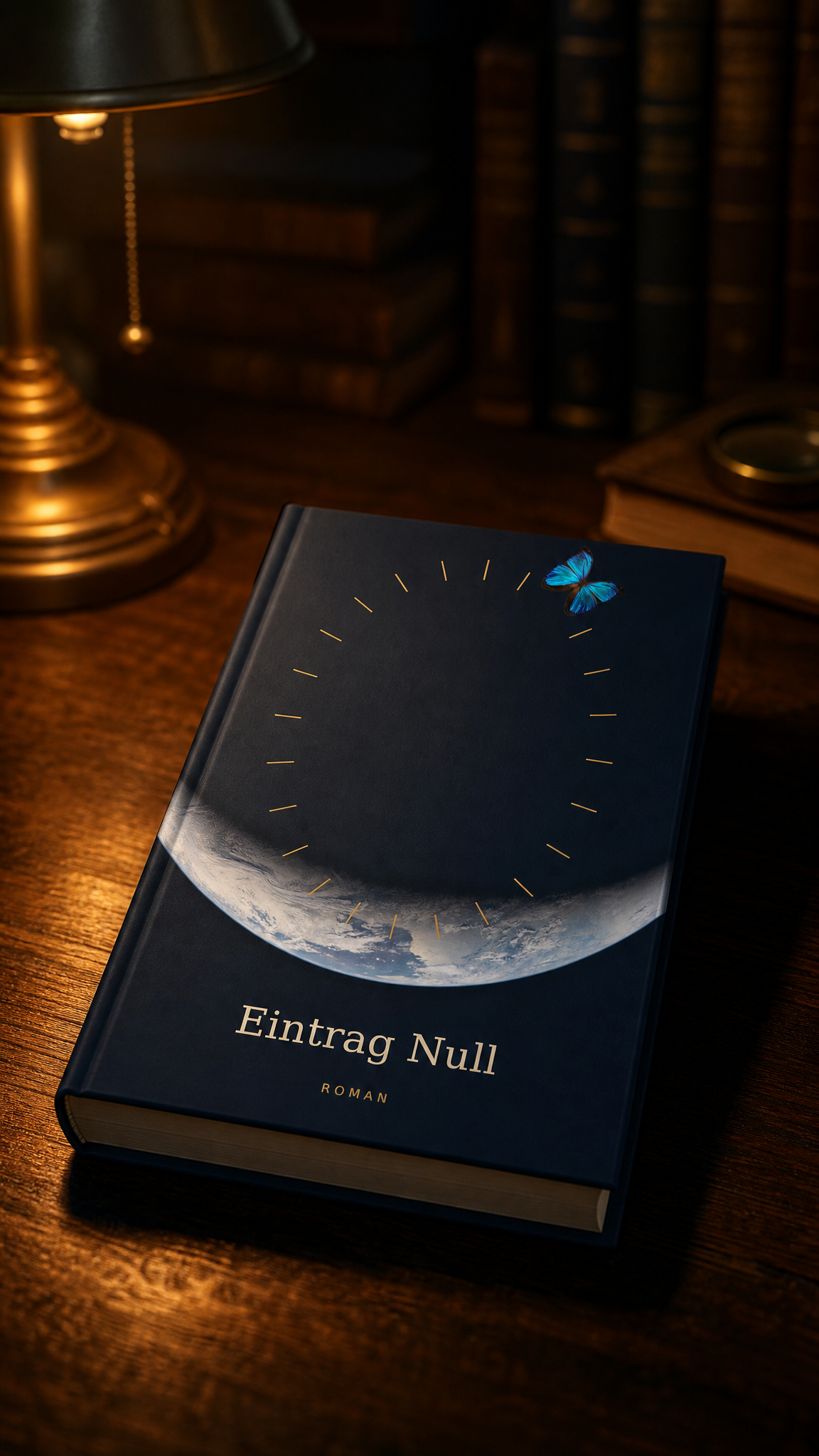
An der kanadischen Pazifikküste beginnen Menschen, ihre Versorgung anders zu organisieren — ohne dass Geld jede Entscheidung trifft. Eintrag Null erzählt, was daraus wird: über drei Generationen einer Gründungsfamilie, von der Pazifikküste über die Alpen bis nach Costa Rica, bis zum Jahr 2100.
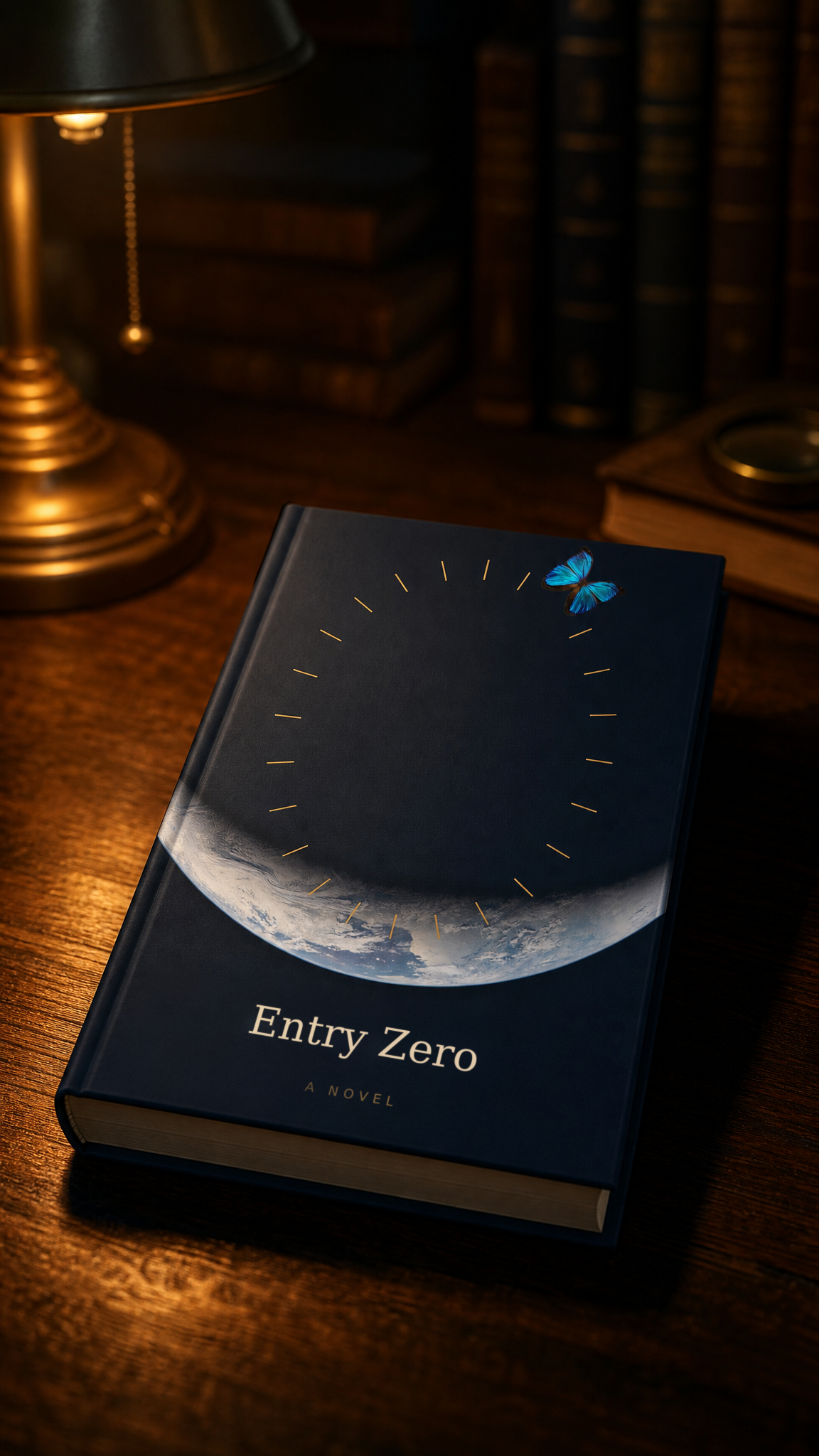
On the Canadian Pacific coast, people begin to organize their provision differently — without money deciding every question. Entry Zero tells what becomes of it: across three generations of a founding family, from the Pacific coast over the Alps to Costa Rica, all the way to the year 2100.
Das Buch ist frei verfügbar, auf Deutsch und auf Englisch.
The book is freely available, in English and in German.
Und wer wissen will, wie dieses Buch entstand: Die Werkstatt erzählt es — als Novelle.And if you want to know how this book came to be: The Workshop tells it — as a novella.
Martin U G P · The Symbios Butterfly Lab
Das Buch
The Book
EINTRAG NULL — Martin U G P
Der Roman lässt sich auf mehreren Ebenen lesen – und er legt sie frei.
Als Erzählung folgt er vier Generationen einer Familie zwischen 2029 und 2100: über eine Insel vor Kanadas Pazifikküste, ein Schweizer Tal und einen costa-ricanischen Regenwald. Getragen von einer fünfzig Jahre währenden Liebe über die Grenze zweier Wirtschaftsordnungen und einem Geheimnis, das älter ist als sie.
Als Weltentwurf zeigt er, wie eine Gesellschaft ohne Geld funktionieren kann: ohne eine zentrale Macht, innerhalb der Grenzen, die unser einziger Planet setzt. Doch der Übergang dorthin hat seinen Preis.
Als Dokument ruht er auf nachprüfbaren Quellen – einem Gerechtigkeitsbericht, einem Weißbuch zur netzbasierten Koordination, einem Klimaszenario des Weltklimarats – und macht sein Gerüst einsehbar.
Als Frage bleibt: Ob eine gerechte Ordnung ohne Unschuld auskommt – und ob eine Gesellschaft, die keine Mitte mehr duldet, es aushält, eben diese Macht in hundert Händen zugleich zu tragen.
ENTRY ZERO — Martin U G P
The novel can be read on several levels — and it lays each of them open.
As a story, it follows four generations of a family between 2029 and 2100: across an island off Canada's Pacific coast, a Swiss alpine valley, and a Costa Rican rainforest. Carried by a love spanning fifty years across the divide between two economic orders, and by a secret older than that love.
As a vision of the world, it shows how a society without money might work: with no central power, within the limits set by our one and only planet. Yet the passage there comes at a price.
As a document, it rests on verifiable sources — a report on global justice, a white paper on networked coordination, a climate scenario from the IPCC — and leaves its framework open to inspection.
As a question, it remains: whether a just order can do without innocence — and whether a society that no longer tolerates a centre can endure holding that very power in a hundred hands at once.
Herunterladen
Download
Der Roman ist vollständig und kostenlos verfügbar. Kein Auszug, keine Anmeldung — das ganze Buch.
The novel is complete and free. No excerpt, no sign-up — the whole book.
Fassung v0.1 — der erste Eintrag. Lizenz: CC BY-NC-SA 4.0 — das Buch darf geteilt und nicht-kommerziell weitergegeben werden, unter Namensnennung und gleichen Bedingungen. Einzelheiten im Impressum.Version v0.1 — the first entry. Licence: CC BY-NC-SA 4.0 — the book may be shared and passed on non-commercially, with attribution and under the same terms. Details in the imprint.
Als Hörbuch
Das ganze Buch, vorgelesen — von der ersten bis zur letzten Seite. Zwei Wege, je nachdem, wie man hört:
In Vorbereitung. Eine gedruckte Ausgabe ist geplant; sobald sie erhältlich ist, steht hier der Weg dorthin.
In preparation. A printed edition is planned; once it is available, the way to it will be here.
Die Grundlagen
The Foundations
Nichts an der Welt dieses Romans ist frei erfunden, und das ist ihre Pointe. Sie beruht auf realen, frei zugänglichen Arbeiten — und auf Papieren, die für dieses Projekt aus ihnen entwickelt wurden. Beides steht hier, klar getrennt: Was es vor dem Buch schon gab, und was die Werkstatt daraus gebaut hat.
Nothing about the world of this novel is freely invented, and that is its point. It rests on real, openly accessible works — and on papers developed from them for this project. Both are here, clearly separated: what existed before the book, and what the workshop built from it.
Die realen Quellen (vorbestehend — nicht von diesem Projekt)
The real sources (pre-existing — not by this project)
Global Justice Report 2026 (World Inequality Lab)Rechnet vor, dass eine gerechte Welt innerhalb der Belastungsgrenzen der Erde bis zum Ende des Jahrhunderts möglich ist. Der Roman übernimmt daraus die Zielbahn — bis zum Zieljahr 2100.Shows that a just world within the load-limits of the earth is possible by the end of the century. The novel takes its target trajectory from it — all the way to the target year 2100. Global Justice Report 2026 →
Integral Technical White Paper v0.1 (Peter Joseph / Integral Collective)Der technische Entwurf einer Wirtschaft, in der nicht Geld und Markt jede Entscheidung treffen. Die Werkzeuge der Föderation im Roman — die Stunden, das Register, die Blaupausen — sind aus diesem System gebaut.The technical design of an economy in which money and the market do not decide every question. The federation's tools in the novel — the hours, the Register, the blueprints — are built from this system. Integral Technical White Paper →
Roadmap for Eradicating Poverty Beyond Growth (2026)Der Weg aus der Armut, gedacht jenseits des Wachstumszwangs. Der Roman nimmt daraus den Versorgungsbegriff: das Genug, nicht das Minimum.The way out of poverty, thought beyond the growth imperative. The novel takes its idea of provision from it: the Enough, not the minimum. Roadmap (PDF) →
IPCC-Szenario SSP1-2.6IPCC scenario SSP1-2.6Das Klimaszenario, dem die Klimakurve des Romans folgt — ehrgeizig, aber innerhalb des wissenschaftlich Beschriebenen.The climate scenario the novel's climate curve follows — ambitious, but within what science describes. IPCC AR6, WG1, Kapitel 4 →
Die Werkstattpapiere (TSBL-Papiere — aus den realen Quellen entwickelt, keine vorbestehenden Dokumente)
The workshop papers (TSBL papers — developed from the real sources; not pre-existing documents)
Wer nach der Lektüre wissen will, wie die Welt des Romans im Einzelnen gedacht ist, findet es hier — vier Papiere, vom Zugänglichen zum Technischen.
If, after reading, you want to know how the world of the novel is thought through in detail, it is here — four papers, from the accessible to the technical.
All four workshop papers are available in English.
Das TSBL-Whitepaper (allgemeinverständlich)The TSBL White Paper (plain language)Das Warum und das Was: die Idee der Föderation, für ein breites Publikum geschrieben.The why and the what: the idea of the federation, written for a broad audience. PDF lesen / herunterladen — TSBL-WhitepaperRead / download PDF — TSBL White Paper
Die Design-Begründung (Design Rationale)The Design RationaleWarum so gebaut und nicht anders: die sieben Gründungsentscheidungen hinter dem System, samt dokumentierten Zweifeln.Why built this way and not otherwise: the seven founding decisions behind the system, documented doubts included. PDF lesen / herunterladen — Design RationaleRead / download PDF — Design Rationale
Wie diese Quellen und Papiere zusammenhängen — was jede beisteuert, an welche Forschung sie anschliesst und wo die Konstruktion offen bleibt —, führt Das Fundament einzeln auf. Es steht in der Werkstatt.
How these sources and papers hang together — what each contributes, which research it connects to, and where the construction stays open — is set out one by one in The Foundation. It stands in the workshop.
Die Welt des Romans misst ihren Erfolg nicht in einer Zahl. Statt eines Bruttoinlandsprodukts führt sie einen Bericht: sechs Dimensionen — Versorgung, Biosphäre, Zeitwohlstand, Resilienz, Gerechtigkeit, Lernen — jede für sich sichtbar, keine gegen die andere verrechenbar. Gezählt wird, nicht bepreist.
The world of this novel does not measure its success in a single number. Instead of a gross domestic product it keeps a report: six dimensions — Provision, Biosphere, Time-wealth, Resilience, Justice, Learning — each visible on its own, none offset against another. Counted, not priced.
Hier lässt sich diese Bilanz erkunden: Der Zeitregler führt von 2030 bis 2100, die Marken zeigen die Ereignisse am Weg, das Band darunter den Anteil der Regionen, die der Föderation beigetreten sind.
Here that balance can be explored: the time slider runs from 2030 to 2100, the marks show the events along the way, and the band beneath them shows the share of regions that have joined the federation.
2100
100 %
Die Bahn zeigt, wohin die Geschichte führt — nicht, was unterwegs geschieht.
The trajectory shows where the story leads — not what happens along the way.
Zum Nachlesen
To read on
Das Werkstattpapier hinter dieser Seite: wie die Lebendige Bilanz gedacht ist, Dimension für Dimension, samt der Frage, warum ein Bericht ehrlicher ist als eine Punktzahl.
The workshop paper behind this page: how the Living Balance is thought through, dimension by dimension, including the question of why a report is more honest than a score.
Diese Seite erzählt, wie das Buch entstand — nicht, was darin geschieht. Die Novelle und die Texte kommen ohne die Handlung des Romans aus. Ein einziger Download, die Pol-Konsistenz-Prüfung, nennt Figuren, Kapitel und einzelne Motive; wer ganz unvorbelastet lesen will, hebt ihn sich für nachher auf.
This page tells how the book was made — not what happens in it. The novella and the texts do without the novel's plot. A single download, the pole-consistency check, names characters, chapters and individual motifs; if you would rather come to the book unprepared, save it for afterwards.
Die Werkstatt
The Workshop
OffenlegungDisclosure
Wie das Buch entstand
How the book was made
Mit einem KI-Sprachmodell wurde das Vorhandene neu geordnet und formuliert; erzählt und entschieden hat ein Mensch. Eine ausführliche Darstellung steht im Nachwort des Buches.
With an AI language model, the existing was reordered and put into words; the telling and the deciding were done by a human being. A full account is given in the book's afterword.
Diese Seite gewährt Einblick in die Werkstatt — erzählt in einer Novelle, bedacht in zwei Texten, geprüft in einer Inventur, die nichts fand. Sie ist der Anfang, nicht der Endstand: Was hier steht, kann wachsen; weitere Dokumente aus der Werkstatt folgen.
This page grants a look inside the workshop — told in a novella, considered in two texts, tested by an inventory that found nothing. It is a beginning, not a final state: what stands here can grow; further documents from the workshop will follow.
ErzählungNarrative
Die Novelle: «Wie man 2026 ein gutes Buch schrieb»
The novella: «How a Good Book Was Written in 2026»
Wer die Werkstatt lieber erzählt bekommt, statt sie zu durchsuchen, beginnt hier: Eine Studentin im Jahr 2050 untersucht für ihre Masterarbeit, wie dieses Buch 2026 mit einem KI-Sprachmodell wirklich entstand — gegen den Widerstand ihres Professors. Fünf Kapitel.
If you would rather have the workshop told than searched, begin here: a student in the year 2050 investigates for her master's thesis how this book was really made in 2026 with an AI language model — against the resistance of her professor. Five chapters.
Wer nur den Befund will, findet ihn hier; wer wissen will, wie Noa dazu kommt, liest zuerst die Novelle.
If you want only the findings, they are here; if you want to see how Noa arrives at them, read the novella first.
Die sechs Bedingungen lesen (rund 600 Wörter)
Sechs Bedingungen, unter denen Erzählen mit einem Sprachmodell Literatur wird, die trägt
Aus der Masterthesis von Noa Lindt, 2050 — dem Befund ihrer viermonatigen Untersuchung eines Romans aus dem Sommer 2026.
Vorab, für alle ohne Vorwissen: Ein Sprachmodell — englisch Large Language Model, kurz LLM — ist ein Computerprogramm, das aus sehr grossen Textmengen gelernt hat, Sprache vorherzusagen und fortzuschreiben; im Alltag sagte man 2026 meist einfach «KI» dazu (künstliche Intelligenz). In jenem Jahr wurden solche Systeme zum ersten Mal breit zum Schreiben benutzt. «Trägt» heisst dabei: Die Sprache ist auf Seite zweihundert noch so frisch wie auf Seite acht; die Fäden der Geschichte erfüllen sich; die Welt bleibt stehen, ohne dass sie erklärt werden muss.
1 — Offenes Material. Das Wissen, aus dem das Buch gebaut wurde, lag frei zugänglich vor jedermann: Berichte, Entwürfe, Szenarien, Forschung. Was Bibliotheken und Ausbildungen jahrhundertelang verschlossen hielten, war offen — nur verstanden werden musste es noch. Oder in Noas Worten: Das Schloss war nie die Tür. Das Schloss war die Zeit.
2 — Ein Motiv. Niemand schneidet eine Tür in ein Haus, das ihm egal ist. Am Anfang eines Buches, das trägt, steht keine Geschäftsidee und kein Experiment, sondern ein Es-geht-so-nicht-weiter — ein Grund, der auch dann noch trägt, wenn niemand zuschaut und nichts dabei zu verdienen ist.
3 — Ein Regelwerk gegen den eigenen Kopf. Wer mit einem Sprachmodell arbeitet, arbeitet mit etwas, das jede Sitzung neu beginnt und alles Mögliche schreiben kann. Dagegen hilft nur ein selbst gebautes Regelbuch — Figuren, Jahre, Weltregeln, Entscheidungen, alles aufgeschrieben, jede Änderung begründet. Nicht aus Ordnungsliebe, sondern aus Statik: Das eigene Gedächtnis ist keine tragende Wand. Das Regelbuch legt keinen einzigen Satz fest — aber es hält jeden Entwurf in der Welt dieses einen Buches: bei seinen Figuren, seinen Jahren, seinem Ton.
4 — Das Verwerfen. Das Sprachmodell liefert auf jede Anfrage unzählige mögliche Fassungen; die eigentliche Arbeit ist das Nein. Zehntausendfach: ansehen, wägen, wegwerfen, neu ansetzen — und das Weggeworfene aufheben, mit Datum und Grund. Denn das Verworfene ist der ehrlichste Beleg, den es gibt: Niemand wirft für ein Publikum weg.
5 — Die neu geeichte Zeit. Das Sprachmodell senkte den Preis des Weges — also die Zeit und Mühe, einen Text überhaupt herzustellen: Was früher Jahrzehnte gekostet hätte, wurde in Monaten gehbar. Was es nie senkte, ist der Preis des Urteils — die Arbeit, zu erkennen, was davon gut ist, und alles andere wegzuwerfen. Wer beides verwechselt, bekommt Durchschnitt in hoher Auflage. Wer es begriff, dem gehörte zum ersten Mal, was jahrhundertelang Höfen, Klöstern und Verlagen gehört hatte: die Mittel, eine Welt zu bauen. Im Jahr 2026 lagen sie auf einem Küchentisch.
6 — Das Einstehen. Am Ende legt ein Mensch genau eine Fassung fest — so und nicht anders —, setzt seinen Namen darunter und beginnt seine Rechenschaft mit dem Teil, der ihm schaden kann — bei diesem Buch: mit der Auskunft, dass ein KI-Sprachmodell als Werkzeug diente. Denn Autorschaft war nie eine Aussage darüber, wie viele Hände — oder welche Werkzeuge — am Text mitgeschrieben haben. Sie ist eine Aussage über Haftung, also darüber, wer dafür geradesteht: Es gibt eine Person, die man fragen kann.
Und die Frage, die nach diesen sechs Bedingungen übrig bleibt, ist nicht mehr «Hat eine Maschine mitgeschrieben?» und auch nicht «War es wirklich einer?». Sie lautet: Wer steht für diese Fassung gerade — und kann man ihn fragen? Wenn die Antwort «niemand genau» heisst, gibt es keine Autorin. Nicht als Strafe. Als Definition.
Read the six conditions (about 650 words)
Six conditions under which storytelling with a language model becomes literature that holds
From the master's thesis of Noa Lindt, 2050 — the findings of her four-month investigation into a novel from the summer of 2026.
First, for readers without background: a language model — a Large Language Model, or LLM — is a computer program that has learned from vast amounts of text to predict and continue language; in everyday speech, people in 2026 mostly just said "AI" (artificial intelligence). That year, such systems were used for writing at scale for the first time. "Holds" means: the language on page two hundred is as fresh as on page eight; the story's threads pay off; the world stands on its own, without ever being explained.
1 — Open material. The knowledge the book was built from lay freely available to everyone: reports, blueprints, scenarios, research. What libraries and formal training had kept locked for centuries was open — it only still had to be understood. Or in Noa's words: The lock was never the door. The lock was the time.
2 — A motive. Nobody cuts a door into a house they don't care about. At the beginning of a book that holds stands no business idea and no experiment, but a this-cannot-go-on — a reason that keeps carrying even when nobody is watching and there is nothing to be earned.
3 — A rulebook against one's own head. To work with a language model is to work with something that starts every session from zero and can write anything at all. The only remedy is a rulebook of one's own making — characters, years, world rules, decisions, all written down, every change with its reason. Not out of tidiness, but out of statics: one's own memory is not a load-bearing wall. The rulebook fixes not a single sentence — but it keeps every draft inside the world of this one book: with its characters, its years, its tone.
4 — The discarding. For every request, the language model offers countless possible drafts; the real work is the No. Ten thousand times over: look, weigh, throw away, start again — and keep what was thrown away, dated and reasoned. Because the discarded material is the most honest evidence there is: Nobody discards for an audience.
5 — Time, recalibrated. The language model lowered the price of the path — that is, the time and effort of producing text at all: what would once have cost decades became walkable in months. What it never lowered is the price of judgement — the work of recognising what is good, and discarding all the rest. Confuse the two, and you get mediocrity in high print runs. Understand it, and you own, for the first time, what for centuries belonged to courts, monasteries and publishing houses: the means to build a world. In 2026, they lay on a kitchen table.
6 — Standing behind it. In the end, one human being fixes exactly one version — this one and no other —, puts their name beneath it, and opens their account of the work with the part that could harm them — in this book's case: with the disclosure that an AI language model served as a tool. Because authorship was never a statement about how many hands — or which tools — helped write the text. It is a statement about accountability, about who answers for it: there is a person you can ask.
And the question that remains after these six conditions is no longer "Did a machine help write it?" nor "Was it really one person?". It is: Who stands behind this version — and can you ask them? If the answer is "no one exactly", there is no author. Not as a punishment. As a definition.
WerkstatttextWorkshop text
Die Landschaft des Möglichen
The Landscape of the Possible
Den ganzen Text lesen (rund 400 Wörter)
Am Anfang jeder Arbeitsstunde an diesem Buch stand eine Frage an eine Maschine, die aus Millionen von Büchern, Berichten und Aufsätzen gelernt hat. Man kann sich diese Maschine als vieles vorstellen. Am ehrlichsten ist vielleicht dieses Bild: Sie ist keine Feder, die schreibt. Sie ist eine Landschaft.
Eine Landschaft aus allem, was Menschen je aufgeschrieben haben — mit Tälern, in denen die vertrauten Geschichten liegen, mit Graten, hinter denen unerwartete Wendungen warten, mit Wegen ohne Zahl. Wer ihr eine Frage stellt, schickt einen Wanderer los. Zwei fast gleiche Fragen, und der Wanderer nimmt zwei völlig verschiedene Wege. Derselbe Weg wird nie zweimal gegangen; die Landschaft wiederholt sich nicht. Aber sie ist auch nicht grenzenlos: Was Sinn ergibt, hält zusammen wie ein Tal seine Wasser.
Geschrieben wird ein Buch in dieser Landschaft nicht vom Wanderer allein. Der Wanderer bringt die Sätze; das Buch entsteht bei dem, der die Wege beurteilt. Hunderte Male hiess das hier: losschicken, ansehen, verwerfen. Einen Schritt behalten, zehn verwerfen. Wieder losschicken, von einem anderen Punkt aus, mit einer anderen Frage. Damit sich das Buch dabei nicht verläuft, führte es sein eigenes Kartenwerk: ein Regelbuch, in dem jede Figur, jeder Ort, jedes Jahr und jede Entscheidung festgehalten ist — der Talrand, der alle Wege im Land dieses einen Buches hält.
Die Werkzeuge dieser Jahre sind dabei rasch besser geworden, und was «besser» heisst, lässt sich im selben Bild sagen: Ein besseres Werkzeug ist eine Landschaft mit tieferen Tälern und längeren Wegen — mehr erreichbare Frische, weniger Abdrift zur Mitte, längerer Atem im gewählten Ton. Was es nicht ist: ein Wanderer mit eigenem Ziel. Lesenswert wurde dieses Buch dort, wo jemand wusste, welchen Weg er sucht — und alle anderen verwarf.
Und am Ende geschah das Wichtigste: Aus unzähligen möglichen Wegen wurde genau einer gewählt und festgelegt. Gedruckt. So und nicht anders. Das ist es, was ein Buch in einer Zeit bedeutet, in der jede Geschichte tausend Fassungen haben könnte: Es ist kein Weg unter vielen mehr. Es ist der Weg, für den jemand geradesteht.
Im Impressum dieses Buches steht dafür ein einziger Satz: Mit einem KI-Sprachmodell wurde das Vorhandene neu geordnet und formuliert; erzählt und entschieden hat ein Mensch. Die Landschaft gehört allen. Der Weg gehört dem, der ihn gegangen ist — und der sagen kann, warum.
Wer tiefer schauen will: Im Werkstatttext «Warum die Maschine nie denselben Text zweimal schreibt» erklären wir, was die Forschung über diese Landschaft inzwischen weiss. Und im Nachwort des Buches steht die ganze Rechenschaft.
Read the whole text (about 450 words)
At the beginning of every working hour on this book stood a question put to a machine that has learned from millions of books, reports and essays. One can picture such a machine in many ways. Perhaps the most honest picture is this: it is not a pen that writes. It is a landscape.
A landscape made of everything people have ever written down — with valleys where the familiar stories lie, with ridges behind which unexpected turns are waiting, with paths beyond counting. To put a question to it is to send out a walker. Two almost identical questions, and the walker takes two entirely different paths. The same path is never walked twice; the landscape does not repeat itself. But neither is it boundless: what makes sense holds together the way a valley holds its waters.
A book in this landscape is not written by the walker alone. The walker brings the sentences; the book comes into being with the one who judges the paths. Hundreds of times over, that meant here: send out, look, discard. Keep one step, discard ten. Send out again, from another point, with another question. So that the book would not lose its way, it kept a set of maps of its own: a rulebook in which every character, every place, every year and every decision is held fast — the valley wall that keeps every path inside the land of this one book.
The tools of these years grew better quickly, and what "better" means can be said in the same image: a better tool is a landscape with deeper valleys and longer paths — more reachable freshness, less drift toward the middle, a longer breath in the chosen tone. What it is not: a walker with a destination of its own. This book became worth reading where someone knew which path he was looking for — and discarded all the others.
And in the end the most important thing happened: out of countless possible paths, exactly one was chosen and fixed. Printed. This one and no other. That is what a book means in an age in which every story could have a thousand versions: it is no longer one path among many. It is the path someone answers for.
In the imprint of this book, a single sentence stands for that: With an AI language model, the existing was reordered and put into words; the telling and the deciding were done by a human being. The landscape belongs to everyone. The path belongs to the one who walked it — and who can say why.
For a closer look: the workshop text "Why the Machine Never Writes the Same Text Twice" sets out what research now knows about this landscape. And the full account is given in the book's afterword.
Erzählen mit dem Gedächtnis der Welt — einstehen muss ein Mensch. Ein Essay über das Erzählen im Zeitalter der Maschinen — und über die ältere Frage, die keine Maschine beantworten kann: wer einsteht.
Telling with the memory of the world — a human must answer for it. An essay on storytelling in the age of machines — and on the older question no machine can answer: who is answerable.
Worauf die Welt von «Eintrag Null» gebaut ist. Vier reale Arbeiten stehen unter dieser Welt, dazu sieben Gründungsentscheidungen und eine private fünfte Quelle. Dieses Papier führt sie einzeln auf: was jede beisteuert, an welche Forschung sie anschliesst — und wo die Konstruktion offen bleibt. Für alle geschrieben, die es nachprüfen wollen; Fachbegriffe werden erklärt, Vorwissen wird nicht vorausgesetzt.
What the world of «Entry Zero» is built on. Four real works lie beneath this world, together with seven founding decisions and a private fifth source. This paper sets them out one by one: what each contributes, which research it connects to — and where the construction stays open. Written for anyone who wants to check; technical terms are explained, no prior knowledge assumed.
Nicht jede Prüfung findet etwas. Eine Inventur ging durch alle Kapitel und fragte, ob Tiere, Pflanzen, Klima und Requisiten zu ihrem Ort gehören — von der Zeder an der Pazifikküste bis zum Faultier im Guanacaste. Sie fand nichts. Auch das gehört ins Register: Was geprüft und für richtig befunden wurde, ist eine Auskunft wie jede andere.
Not every check finds something. One inventory went through every chapter and asked whether the animals, plants, climate and props belong where they stand — from the cedar on the Pacific coast to the sloth in the guanacaste. It found nothing. That belongs in the register too: what has been checked and found sound is a piece of information like any other.
Ein Buch entsteht nicht in einer Fassung. Dieses hier begann im Juni 2026 mit einem Exposé und wurde von da an Ebene um Ebene neu geschrieben: erst der Plan, dann das Kanonbuch, das jede Figur und jede Jahreszahl festhält, dann die Kapitel, dann die englische Ausgabe, dann die Werkstatt, die davon erzählt.
A book does not come into being in one version. This one began in June 2026 with a synopsis and was rewritten from then on, layer by layer: first the plan, then the canon book that holds every character and every year, then the chapters, then the English edition, then the workshop that tells of it.
Was hier steht, ist keine Erklärung. Es ist eine Zählung.
What stands here is not an explanation. It is a count.
Ebene
begonnen
Fassungen
Stand
Das Exposé
Juni 2026
18
v0.18
Die Roman-Bibel — das Kanonbuch, in dem jede Figur, jedes Jahr und jede Weltregel steht
The Translation Bible — the canon book of the English edition
25 June 2026
51
v0.51 · 12 July 2026
The 28 chapters, English
June 2026
56
last July 2026
The ten exhibits, English
June 2026
18
last July 2026
The full manuscript, English
June 2026
7
v0.7
The four workshop papers (all four also in English)
17 June 2026
42
last 12 July 2026
The two workshop texts
17 June 2026
7
last 12 July 2026
The essay, German and English
5 July 2026
9
v0.6 / v0.3 · 12 July 2026
The novella
July 2026
6
v0.6 · 12 July 2026
This website
10 July 2026
22
12 July 2026
The book
v0.1
the first entry
Altogether: 575 versions. The book that came of it carries the number v0.1.
Mitschreiben
Write On
Dieses Buch trägt seine Fassungsnummer sichtbar: Veröffentlicht ist v0.1 — der erste Eintrag in ein Register, das offen bleibt. Was Leserinnen und Leser zurückspielen, kann in eine spätere Fassung einfliessen oder in andere Geschichten aus derselben Welt.
This book carries its version number visibly: what is published is v0.1 — the first entry in a register that stays open. What readers send back can flow into a later version, or into other stories from the same world.
Eine Idee einreichen
Submit an idea
Eine Beobachtung, ein Widerspruch, eine Figur, die noch fehlt, ein Ort, der noch nicht erzählt ist — alles ist willkommen. Kurz oder lang.
An observation, an objection, a character still missing, a place not yet told — everything is welcome. Short or long.
Eingereichte Beiträge stehen unter derselben Lizenz wie das Buch: CC BY-NC-SA 4.0. Wer einreicht, ist einverstanden, dass der Beitrag unter dieser Lizenz in spätere Fassungen oder weitere Geschichten einfliessen kann — mit Namensnennung, wenn gewünscht.
Submitted contributions stand under the same licence as the book: CC BY-NC-SA 4.0. Whoever submits agrees that the contribution may flow into later versions or further stories under this licence — with attribution, if desired.